Thai cuisine is one of the world’s most beloved culinary traditions, but its signature high-heat wok techniques and charcoal grilling produce emission profiles that rival or exceed Sichuan and Hunan cooking. From the explosive stir-frying of Pad Kra Praw to the sustained fat rendering of Moo Ping skewers, Thai restaurant kitchens demand segregated, multi-stage ventilation strategies combining water-curtain pre-treatment, heavy-duty electrostatic precipitation, and activated carbon polishing.
The Dual Emission Profile of Thai Kitchens
Thai restaurant kitchens operate with a distinctive dual-zone emission profile that mirrors the cuisine’s balance between aggressive high-heat cooking and delicate dessert preparation. Understanding this split is essential for designing ventilation systems that protect both air quality and food quality.
Heavy-Smoke Zone: Wok Stations and Charcoal Grills
The heavy-smoke zone encompasses the core of Thai kitchen operations. Five signature cooking methods produce emission loads comparable to or exceeding the most intensive Chinese wok cooking:
Pad Kra Praw (Holy Basil Stir-Fry): This iconic dish requires sustained high-heat wok cooking at 250-300°C, where minced meat is seared alongside bird’s-eye chilies, garlic, and holy basil in a wok preheated to near-smoking temperature. The rapid fat vaporization produces high-concentration carbon-black particulates, vaporized animal fats, and Maillard-reaction VOCs. The addition of oyster sauce and fish sauce at peak temperature generates acrolein and other aldehyde compounds that are both pungent and persistent.
Pad Thai (Stir-Fried Rice Noodles): Though perceived as a milder dish, authentic Pad Thai preparation involves wok-hei (breath of the wok) techniques at 220-280°C. The tamarind sauce caramelizes on the wok surface, producing sticky sugar-pyrolysis particulates that adhere to ductwork. The protein components (shrimp, tofu, egg) each contribute different fat-aerosol profiles, and the high-temperature toss creates plumes of blue-grey smoke that contain fine particulate matter (PM2.5) at concentrations exceeding 2,000 µg/m³ at the hood face.
Moo Ping (Charcoal Grilled Pork Skewers): These marinated pork skewers are grilled over charcoal at 350-450°C, producing continuous fat-drip pyrolysis. The marinade (containing coconut milk, fish sauce, and palm sugar) creates a complex emission cocktail: carbon-black particulates from incomplete charcoal combustion, vaporized coconut fat at 200°C drip temperature, and caramelized sugar pyrolysis products. The sustained 2-3 hour grilling session generates a steady-state emission load that requires continuous high-capacity extraction.
Fried Fish Cakes (Tod Mun Pla): Deep-frying at 180-200°C produces dense white aerosol plumes from the red curry paste and fish protein. The kaffir lime leaves in the mixture release volatile terpenes (citronellal, limonene) that are detectable at extremely low thresholds and travel far beyond the kitchen envelope. The breading material generates fine starch particulates that penetrate deep into filter media.
Stir-Fried Morning Glory (Pad Pak Boong): This deceptively simple vegetable dish requires the most aggressive wok technique of all Thai cooking. The morning glory is stir-fried at maximum heat (300-350°C) with fermented bean paste, oyster sauce, and bird’s-eye chilies in a technique called “phoon” that involves flash-frying in a wok with the flame climbing up the sides. The water content in the morning greens creates steam-explosion aerosol that carries grease particulates upward at high velocity, requiring capture velocity of at least 0.5 m/s at the hood face.
Light-Smoke Zone: Dessert and Snack Stations
The light-smoke zone covers the Thai dessert and snack preparation areas, which produce minimal visible grease but significant aromatic emissions:
Kanom Krok (Coconut-Rice Pancakes): Cooked on specialized cast-iron indent pans at 150-180°C, these bite-sized snacks produce primarily coconut-milk vapor and rice-flour starch particles. The emissions are predominantly aromatic rather than particulate, but the coconut fragrance is intense and can persist in ventilation ductwork.
Kanom Ba Bin (Grilled Coconut Cake): Baked in oven or on griddles at 160-200°C, producing dry thermal plumes with caramelized sugar notes and minimal grease. The main concern is heat removal rather than grease capture.
Baked Coconut Tarts and Pandan Toast: These items produce malt, caramelization, and pandan-leaf aromatic compounds (2-acetyl-1-pyrroline) that are detectable at parts-per-billion levels. While not a grease hazard, these aromas can cause neighbor complaints if exhausted untreated.
Technical Specifications
| Parameter | Specification |
|---|---|
| Thai Cuisine Emission Sources | Wok stir-fry (Pad Kra Praw, Pad Thai, Morning Glory): 250-350°C sustained high-heat cooking producing carbon-black particulates, vaporized fats, and acrolein; Charcoal grill (Moo Ping): 350-450°C with fat-drip pyrolysis and incomplete combustion aerosols; Deep fry (Tod Mun): 180-200°C dense white aerosol with curry-paste VOCs; Dessert station (Kanom Krok, tarts): 150-200°C light aromatic plumes |
| Smoke Classification | Heavy-smoke zone (wok + grill + fry): emission load equal to or exceeding Sichuan/Hunan cuisine; Light-smoke zone (desserts): far below Sichuan/Hunan, primarily aromatic |
| Design Approach | Dual-zone segregation: heavy-smoke wok/grill zone with water-curtain pre-treatment + dual-stage plate-type or honeycomb heavy-duty ESP + V-bank heavy activated carbon; Light-smoke dessert zone with compact single-stage ESP or ventilation box + pre-filter mesh + standard activated carbon pad; Separate duct runs for each zone to prevent cross-contamination |
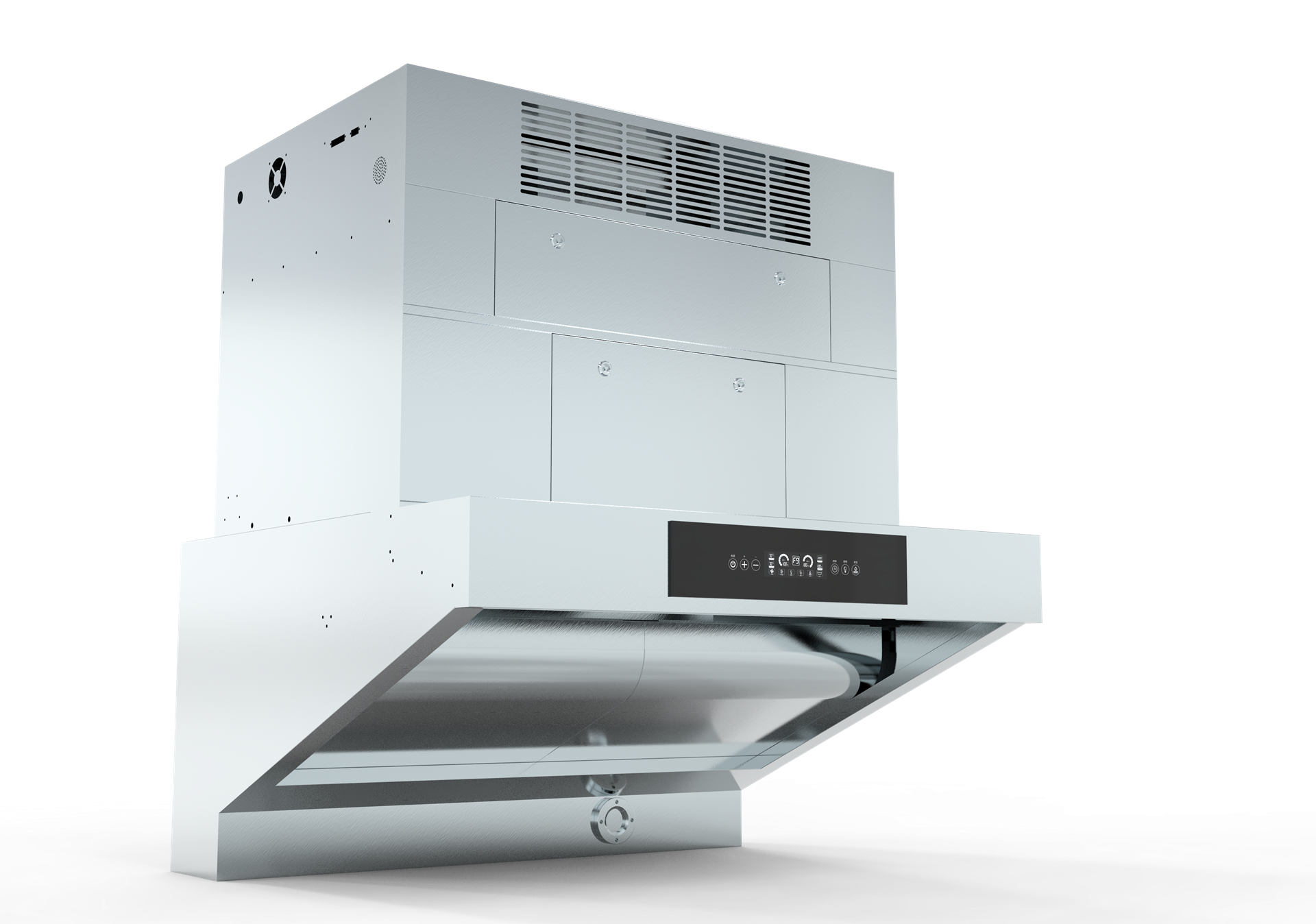
| Recommended Souniny Solutions | Heavy-duty Series for wok and grill stations (water-cycle + ESP + polymer + deodorization); Water Spray Purifier as pre-filter for charcoal grill station; Light-duty Series or Little Prince Series for dessert station; Odor Removal Tower for dining-area-adjacent finishing; Cabinet Purifier for open-kitchen zonal polishing; Self-cleaning ESP for sustained high-fat Moo Ping operations |
| Design Parameters | 250-350 CFM per wok burner station; 200-300 CFM per linear meter of charcoal grill; 150-200 CFM per deep fryer; 25-35 CFM per m² dessert station; Duct velocity 12-15 m/s near wok; 8-10 m/s in dessert section; Grease-rated ductwork with cleanout access every 3 m; Make-up air balanced for open-plan Thai kitchen layouts; Noise under 55 dBA in dining area |
| Key Pollutants | Carbon-black particulates (PM2.5 and PM10); Vaporized animal fats (pork, shrimp, fish); Acrolein and aldehydes from high-temperature oil; Caramelized sugar pyrolysis products; Coconut-milk fat aerosol; Curry paste VOCs (turmeric, galangal, lemongrass terpenes); Kaffir lime leaf terpenes (citronellal, limonene); Fish sauce amine compounds |
| Regulatory Context | Thai restaurants in Europe must comply with EN 16282; US locations follow NFPA 96 and UL 710B; ASEAN markets follow local EPA equivalent standards; Odor nuisance regulations vary by jurisdiction but kaffir lime and fish sauce aromas frequently trigger complaints |
Specifications are typical for Thai restaurant applications. Exact values vary by kitchen size, menu scope, and local regulations. Contact Souniny for a site-specific ventilation design.
Recommended Souniny Solutions
Based on the dual-zone emission profile of Thai kitchens, Souniny recommends a segregated ventilation architecture that matches equipment to each zone’s specific emission characteristics:
Heavy-Smoke Zone: Wok and Grill Stations
For the wok station handling Pad Kra Praw, Pad Thai, and Morning Glory stir-frying, the recommended configuration begins with a water-curtain hood (or Water Spray Purifier as a first-stage pre-treatment) that quenches the high-temperature plume and captures the largest grease particulates. This pre-treatment stage is critical because Thai wok cooking produces flash-fire temperatures that can ignite grease deposits in standard baffle filters.
Downstream of the water curtain, a dual-stage ESP configuration provides the primary particulate capture. The first stage uses a plate-type ESP cell for bulk particulate loading, followed by a honeycomb ESP cell for fine-particle polishing. This dual-stage approach achieves over 98% removal efficiency on sub-micron grease particles that would otherwise pass through single-stage systems.
For the Moo Ping charcoal grill station, the same water-curtain pre-treatment is essential for two reasons: first, it captures the carbon-black particulates from incomplete charcoal combustion before they can foul the ESP cells; second, it provides a spark-arresting function that prevents ember carryover into the ductwork, addressing a critical fire safety concern for charcoal operations.
The final stage in the heavy-smoke duct run is a V-bank activated carbon filter sized for the high odor load of Thai cuisine. The carbon must be rated for both grease and VOC absorption, as Thai cooking produces a complex mixture of aldehyde compounds, terpenes, and amine compounds that require broad-spectrum adsorption media. Expect carbon replacement intervals of 3-4 months under normal Thai restaurant operating hours (8-12 hours per day).
Light-Smoke Zone: Dessert and Snack Stations
For the dessert preparation area handling Kanom Krok, coconut tarts, and pandan toast, a compact single-stage ESP or an independent ventilation box with a pre-filter mesh and standard activated carbon pad provides sufficient treatment. These stations produce minimal grease loading, so the primary objective is heat removal and aromatic compound adsorption rather than particulate capture.
The Light-duty Series or Little Prince Series is well-suited for this application, providing adequate airflow (800-2,000 m³/h) with low energy consumption (200-350W) and quiet operation suitable for customer-adjacent open kitchens. The activated carbon pad should be replaced every 2-3 months to prevent aromatic breakthrough, particularly for the persistent pandan and coconut fragrances.
Dining Area Protection
Thai restaurants frequently feature open kitchens or semi-open cooking stations where the dining area is directly exposed to cooking emissions. For these layouts, an Odor Removal Tower positioned at the boundary between kitchen and dining area provides a final polishing stage that captures escaping aromatic compounds. This is particularly important for restaurants serving Moo Ping and Pad Kra Praw, whose aromas are intense and can overwhelm the dining experience if not properly managed.
Application Scenarios
Scenario 1: Downtown Bangkok Street-Food Style Restaurant — A 60-80 seat restaurant with two wok stations, one charcoal grill, and one deep fryer. The heavy-smoke zone requires 800-1,200 CFM total extraction with water-curtain pre-treatment, dual-stage ESP, and V-bank activated carbon. A separate dessert station uses a compact ESP unit at 400 CFM. The kitchen operates 10-14 hours daily, requiring ESP cell cleaning every 3 weeks and carbon replacement every 3 months.
Scenario 2: Suburban Thai Family Restaurant in Europe — A 40-60 seat restaurant serving a simplified menu with one wok station and a small grill. EN 16282 compliance requires captured grease removal efficiency above 95%. The recommended configuration uses a Heavy-duty Series ESP with integrated water spray pre-treatment, achieving 98%+ efficiency. The compact footprint suits the smaller kitchen, and the CE certification satisfies European market requirements. Activated carbon is particularly important here because European neighbor-odor-nuisance regulations are strict.
Scenario 3: Thai Food Court Stall in a Shopping Mall — A compact 15-20 m² stall with one wok and limited ductwork access. The Ventless Catering Carts or a ductless range hood configuration is ideal, as these units recirculate air through multi-stage filtration without requiring external ductwork. The four-layer filtration system (baffle + ESP + polymer filter + deodorization module) handles the heavy Pad Thai and Pad Kra Praw cooking loads while maintaining mall air quality standards.
Scenario 4: High-Volume Thai Chain Restaurant — A 120+ seat chain location with three wok stations, two charcoal grills, a dedicated fryer line, and a separate pastry section. The heavy-smoke zone uses a centralized ESP system with water-spray pre-treatment handling 2,000-3,000 CFM, with a Self-cleaning ESP unit to minimize maintenance downtime across the 16-hour operating day. The pastry section uses an independent Light-duty Series unit. Building Management System integration via MODBUS enables remote monitoring of ESP cell voltage, fan status, and filter pressure differentials.
Scenario 5: Thai Catering and Banquet Operations — Off-site Thai catering for events of 200-500 guests requires portable ventilation. The Ventless Catering Carts series provides mobile cooking stations with integrated ESP purification, enabling live Pad Thai or Moo Ping preparation at event venues without fixed kitchen infrastructure. The self-contained water-cycle system handles the heavy grease load while the ESP stage ensures compliance with venue air quality requirements.
Maintenance and Compliance
Thai kitchen ventilation systems require disciplined maintenance schedules due to the high grease and particulate loading:
ESP Cell Cleaning: For heavy-smoke zone ESP cells handling wok and charcoal grill emissions, cleaning every 3 weeks is mandatory under normal operating hours. The Self-cleaning ESP option reduces this burden by automating the wash cycle, but manual inspection of cell integrity and high-voltage insulators should still occur monthly. For light-smoke zone units, cleaning intervals can extend to 2-3 months.
Activated Carbon Replacement: The complex VOC profile of Thai cuisine (curry paste terpenes, fish sauce amines, kaffir lime citronellal) saturates activated carbon faster than typical Western kitchen operations. Expect 3-month replacement intervals for heavy-smoke zone V-bank filters and 2-3 month intervals for light-smoke zone carbon pads. Monitor for odor breakthrough, particularly the distinctive fish-sauce amine smell, as an early indicator of carbon exhaustion.
Ductwork Cleaning: The sticky sugar-pyrolysis deposits from Pad Thai and caramelized marinade from Moo Ping accumulate rapidly in ductwork. Schedule professional duct cleaning every 3-4 months for the heavy-smoke zone, with grease-access cleanout panels every 3 meters of duct run. The water-curtain pre-treatment significantly reduces duct loading by capturing the largest particulates before they enter the duct system.
Fire Safety: Charcoal grill operations present elevated fire risk due to ember carryover. The water-curtain first stage provides spark-arresting capability, and all ductwork in the heavy-smoke zone must be grease-rated with accessible cleanout panels. NFPA 96 compliance requires quarterly inspection of fire suppression systems in the hood and ductwork, with particular attention to the charcoal grill station.
Regulatory Compliance: Thai restaurants operating in Europe must ensure their ventilation system meets EN 16282 requirements for commercial kitchen ventilation, including captured grease efficiency and emission limits. US locations must comply with NFPA 96 and, where applicable, UL 710B for exhaust hood systems. In ASEAN markets, local environmental protection regulations typically specify particulate emission limits of 1-2 mg/m³ at the exhaust point, which the dual-stage ESP configuration achieves with margin.
Conclusion
Thai restaurant kitchens present a uniquely challenging ventilation environment that combines the most aggressive wok cooking techniques with intense aromatic compounds from herbs, spices, and fermented ingredients. The dual-zone segregation strategy — heavy-duty water-curtain + dual-stage ESP + activated carbon for wok and grill stations, and compact single-stage ESP for dessert areas — provides the most effective and cost-efficient approach. Souniny’s comprehensive product line, from the Heavy-duty Series through the Light-duty Series and Ventless Catering Carts, enables Thai restaurant operators to match equipment precisely to each cooking zone’s emission profile, ensuring regulatory compliance, fire safety, and a pleasant dining environment free from grease and odor intrusion.