Craft brewery taprooms and grain-to-glass distilleries have moved well past the pint-and-snack-bar model. By 2025, more than nine thousand operating US craft breweries, and a growing wave of craft distilleries, pair each pour with a substantial food menu — wood-fired pizzas, beer-battered fish, smoked brisket sliders, charcuterie boards finished tableside, bourbon-glazed wings over open flame, and small-plate tasting flights seared on induction or solid-fuel cooktops. That convergence of brewing process heat, live-fire cooking, dense customer occupancy, and heritage-building architecture has created a ventilation category that the original Type-I-hood-and-upblast-fan playbook was never designed to cover. Operators routinely retrofit draft systems into century-old brick warehouses, top-floor timber buildings, and transit-adjacent retail spaces with no service access for straight duct risers. Front-of-house cooking is often visible — and the air the customer breathes is the air the kitchen just cooked into. This article explains how electrostatic precipitation (ESP) fits the craft brewery and distillery taproom ventilation brief, why the cookline emissions in these venues are categorically different from a conventional casual-dining kitchen, and which Souniny configurations solve the most common field problems.
Why Taproom Kitchens Are a Ventilation Category of Their Own
Three things make taproom and distillery-tasting-room kitchens different from standard commercial cooking operations. First, the air intake already carries process byproducts. Mash-tun steam, hop particulate from dry-hopping vessels, and grain dust from milling rooms occupy the same envelope as the cooking line, and a conventional economizer or make-up air unit can sweep those contaminants across the dining floor before the hood even sees them. Second, the menu load is bimodal: very heavy char and wood smoke from grill stations, pits, and pizza ovens, combined with extremely light finishing work — cheese melts, sauce reductions, plating under heat lamps — that never quite justifies a second Type I hood run. Third, square-footage economics push the cookline directly against the bar, often within ten feet of customer seating. The soot, VOCs, and polycyclic aromatic hydrocarbons that come off real wood-fired and solid-fuel cookers therefore enter the breathing zone at velocities and concentrations that an open dining room treats as unacceptable.
The classic remedy — a massive canopy hood with thousands of cubic feet per minute of exhaust per linear foot of cookline, a rooftop upblast fan, and a packaged make-up-air unit — usually fails three of the site constraints at once. Heritage buildings prohibit exterior rooftop equipment or visible stacks. Barrel-storage cellars and finished-second-floor mezzanines cannot accept vertical duct penetrations. And many jurisdictions now require conditioned make-up air equal to exhaust volume, which drives heating and cooling costs past what a small-footprint taproom can absorb. A duct-mounted electrostatic precipitator operating in series with a properly sized Type I hood rebalances those equations: the ESP allows the designer to size the hood for capture-and-contain rather than for dilution, drops the required exhaust airflow by a meaningful margin versus an unfiltered installation, recovers heat through a recirculating service path, and produces a clean effluent stream that the AHJ will accept at the discharge point.
Pollutant Profile of a Craft Brewery or Distillery Taproom Cookline
The cookline in a modern taproom produces a profile that no single product category was originally engineered for. Live-flame wood-fired pizza ovens — fuelled with oak, pecan, apple, or cherry wood — drive sub-micron particulate, terpenes from wood volatiles, and polycyclic aromatic hydrocarbons (PAHs) at high temperatures, often outside the hood capture envelope unless the oven door is closed. Charbroilers and over-fire grills using lump hardwood charcoal contribute similar but heavier grease-loaded emissions, with visible smoke plumes rich in condensable organics. Wood-fired smokers for pulled pork, brisket, and sausage add slow-tember visible smoke plus significant creosote condensate, which is the hardest residue for any filtration system to shed. At the other end of the cookline, beer-battered fryers add loadings of fine aerosolized oil droplets with a particle-size distribution skewed to the sub-micron range — a profile that ESP handles efficiently and that mechanical filtration handles only with very high pressure drop.
Adjacent to the cookline, hot-holding wells, salamanders, cheese melters, and finishing induction ranges add light thermal plumes with negligible grease load. Charcuterie service lines, often with a quiet butane ring or infrared strip for caramelizing the rind on a mountain cheese, add a small but customer-adjacent emission that occupies the breathing zone. The bar itself contributes espresso-roastery emissions in venues that operate a craft coffee program, and the distillery tasting room adds ethanol and congener off-gassing from barrel storage, particularly during low-pressure ambient venting in winter. Each of these streams has a characteristic challenge: the heavy grilling stream wants large cross-section hood coverage and aggressive grease capture, the live-fire pizza stream wants high-temperature-rated ductwork, the charcuterie stream wants point-source capture at very low flow, and the brewing-process stream wants particulate filtration without competing with the cooking line for return air.
Standards and Code Compliance for Taproom Ventilation
Taproom and tasting-room kitchens sit at the intersection of several code paths. In the United States, NFPA 96 (Standard for Ventilation Control and Fire Protection of Commercial Cooking Operations) governs hood, duct, and fire-suppression design, with the International Mechanical Code adding requirements for make-up air balance and exhaust discharge. For wood-fired cookers specifically, UL 710B provides the test protocol for grease-rated hoods over solid-fuel cooking. In the European Union, the EN 16282 series frames the equivalent requirements for kitchen exhaust, with member-state regulations (the German VDI 2052, French and Italian implementations of EN 16282, and the UK documents that succeeded the older DW172 guidance) tightening recirculation, fire isolation, and clean-air discharge limits. Australia references AS 1668.2, while GCC standardization increasingly aligns with NFPA 96 as the underlying basis.
Two compliance themes dominate taproom projects. First, the discharge condition: most jurisdictions require that kitchen exhaust either vent above the roofline, or pass through a verified cleaning device before any recirculation or side-wall discharge is permitted. A duct-mounted ESP that achieves high油烟净化效率 on the relevant cooking aerosol is generally acceptable to US, EU, and Australian authorities when the unit is correctly applied and maintained. Second, the fire-protection envelope: solid-fuel cooking in particular requires listed grease-rated ductwork, clearances to combustibles, and a firestat or sprinkler tie-in inside the ESP plenum. Equipment that integrates these requirements without an external fire damper module — such as the Self-cleaning ESP and the ESP Auto-cleaner configurations — accelerates AHJ approval considerably on retrofit projects.
Souniny Equipment Mapping for Taproom and Distillery Kitchens
Souniny supplies a duct-mounted and cabinet-format ESP family that maps cleanly to the cooking lines installed in modern craft taprooms. Every model referenced here is a real product page on the Souniny site; none of the equipment names below are model codes.
Heavy-Duty Cookline: Wood-Fired Oven, Charbroiler, Fryer Stack
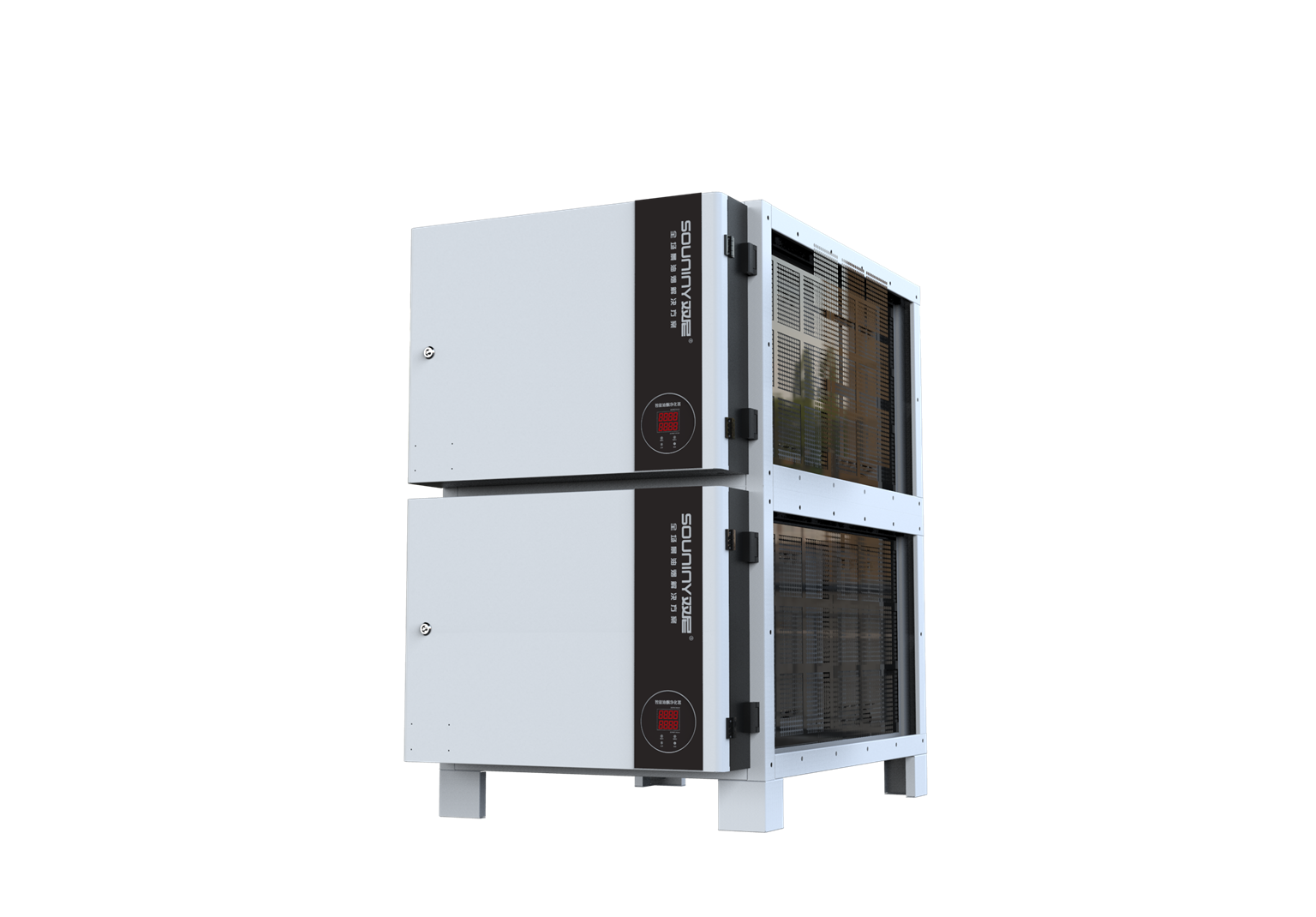
The dominant cooking line in a taproom kitchen — wood-fired pizza oven flanked by a multi-burner char broiler and a double-vat fryer bank — produces the heaviest grease and visible-smoke load. The standard Souniny recommendation is the Heavy-duty Series, built around a ducted two-stage electrostatic cell. The first stage is a corrosion-resistant stainless pre-filter that strips the high-mass grease droplets by impaction, dropping them into a removable collection tray and protecting the ionizing field from fouling. The second stage is a high-voltage ionizing collector section designed for the sub-micron aerosols common in wood-fired and beer-batter applications. The unit is installed in line with the Type I hood exhaust riser, downstream of the firestat and any required fire-suppression nozzle, and upstream of the discharge stack or recirculation blower.
The Heavy-duty Series is the right choice when the hood serves more than four linear feet of solid-fuel cooking, when the operating profile includes sustained charbroil duty, or when the venue is preparing for a future expansion of the cooking platform.
Light-Duty Cookline: Finishing, Charcuterie, Hot Holding
The finishing section of a taproom kitchen — cheese melting, sauce finishing, charcuterie sear, plate-up under heat lamps — produces a much lighter thermal plume. The Light-duty Series addresses this profile with a lower-velocity cabinet-format ESP that mounts directly under the hood section or as a stand-alone wall unit beside the finishing station. It is the right selection for venues that want to capture and clean the air around the charcuterie board and finishing induction range without paying for the heavier cell stack and higher static pressure of a full ducted installation.
Centrifugal Fan Sizing for Taproom Applications
ESP units do not generate their own draft. The Centrifugal Fan range supplied by Souniny pairs with the duct-mounted ESP and is selected to deliver the hood’s specified capture face velocity at the static pressure the ESP cell demands. Because ESP lets the designer oversize the capture hood without oversizing the fan, the centrifugal fan that follows the ESP cell can be selected at a lower brake-horsepower rating than the equivalent dilution-only installation, often reducing operating cost meaningfully on a continuously operating taproom.
Compact Bar Counter and Tasting Flights
The smallest footprint on the cookline — a single butane sear station for cheese plating, a coffee-roastery bar, or a barrel-top cocktail garnish station — often does not justify any duct work at all. The Cabinet Purifier addresses this profile as a recirculating cabinet-format air cleaner that mounts under the bar top or beside the station, capturing and returning the cleaned air to the immediate breathing zone. The same cabinet format is the right selection for the Snack Cart Purifier configuration used at tasting events where each table receives a small individual cooking station. Both units are quiet enough to operate next to customer seating without intruding on the conversation space.
Front-of-House Tasting Flights with Live Cooking
Taprooms that build the tasting flight around tableside cooking — flambéed bourbon cherries, beer-cheese fondue tableside, micro-char of cured meats — increasingly rely on the Water-cycle BBQ Cart and the Ventless Catering Carts family. The Countertop Cart and the Tempered Glass Cart are ductless recirculating carts that integrate ESP with an internal washdown tank, allowing live-flame tableside cooking without a permanent hood installation. The Water Spray Purifier is the recommended add-on when the live-cooking profile produces visible wood smoke rather than just grease aerosol, because water-spray scrubbing addresses condensable VOCs that electrostatic precipitation alone handles less efficiently.
Process Air and Roastery Off-Gassing
The brewing, distilling, and coffee-roasting process itself produces a parallel stream that wants treatment. The grain dust from milling rooms, the hop particulate around dry-hopping vessels, the ethanol and congener off-gassing from aging barrel warehouses, and the visible smoke from the green-bean coffee roaster in a roastery-bar all benefit from an Odor Removal Tower mounted at the duct discharge. The tower uses a layered activated-carbon and optional UV photolysis stage to polish the airstream before it leaves the discharge point, addressing neighborhood odor complaints that frequently delay permitting for new taprooms in mixed-use districts.
Recommended Souniny Solution Stack for a Standard Taproom
For a typical craft brewery with a wood-fired pizza oven, charbroiler, double fryer, charcuterie station, and a coffee-roastery bar, the recommended Souniny equipment stack is as follows. The main cookline Type I hood runs the Heavy-duty Series ducted ESP, paired with the appropriately sized Centrifugal Fan downstream. The finishing and charcuterie stations operate behind a small canopy hood handled by a Light-duty Series cabinet-format ESP. The bar-side coffee roastery and barrel-aging off-gassing stream are served by an Odor Removal Tower at the discharge of the bar’s dedicated exhaust riser. Tableside live-cooking flights at reserved seats are served by one or two Ventless Catering Carts (typically the Tempered Glass Cart for visual appearance) on a per-server basis. The combined ducted and ductless architecture means no rooftop equipment is required, and total exhaust airflow drops by a substantial margin compared with a dilution-only design.
Light-duty Series
ESP Purifiers
Cabinet Purifier
Centrifugal Fan
Odor Removal Tower
Smart Water Tank
Water Spray Purifier
Countertop Cart
Tempered Glass Cart
Water-cycle BBQ Cart
Installation Notes for Heritage and Retail-Embedded Taprooms
The majority of craft brewery and distillery taproom projects are retrofit installations into buildings that were not designed as commercial kitchens. Common field realities include: timber-framed roof structures that will not accept a rooftop upblast fan; heritage brick walls that cannot be penetrated for a vertical discharge stack; second-floor mezzanines above the cookline that cannot take a vertical duct riser; and shared-lease mixed-use buildings where rooftop equipment is excluded by the property covenant. The ducted ESP configuration answers each constraint by relocating the discharge either horizontally through an exterior wall where local code allows, or back into the building envelope as cleaned recirculation. The Self-cleaning ESP and the ESP Auto-cleaner configurations further reduce the maintenance burden in installations where the duct is long, concealed, and physically hard to access for periodic cell washing.
Maintenance and Service Intervals
An ESP that is correctly sized and applied does not change the principle that preventive service drives long-term performance. For taproom installations operating twelve to sixteen hours a day, six days a week, the field-proven schedule is a weekly visual check of the cell, a two-week pre-filter rinse, a four-week cell wash cycle which the Smart Water Tank automates, and a quarterly inspection of the high-voltage power supply, ionizing wires, and grounding. Souniny products ship with a 12-month whole-unit warranty under the standard warranty terms, with the ESP cell, aluminum collector plates, sealing strips, and ceramic insulators designated as consumable wear items that are replaced on a service schedule rather than under warranty. Souniny provides remote technical support and ships replacement components directly from Dongguan, so the operator is not dependent on a local service agent for routine maintenance.
Operational Economics: Why ESP Pays Back in a Taproom
The economic argument for ESP in a craft taproom is stronger than in a conventional full-service restaurant for three reasons. First, the exhaust volume reduction drops the brake horsepower of the operating fan, which directly cuts electricity cost. A meaningful reduction in cfm on a typical cookline operating fifteen hours a day, six days a week, recovers a substantial share of the operating fan’s energy cost. Second, the make-up air unit, which on a US project now must deliver conditioned air equal to the exhaust volume under the IMC, drops in proportion, recovering both winter heating and summer cooling load. Third, the ability to recirculate treated air rather than dumping it above the roofline allows the building envelope to retain heat in winter and conditioned air in summer, which on a drafty timber-framed heritage brewery is the single largest HVAC line item. Most operators recover the equipment capital cost inside the first three years, with the recirculation airside savings continuing for the service life of the unit.
Application Scenarios
The configurations described above map to a defined set of real-world taproom and distillery installations. A wood-fired-pizza-and-craft-beer flagship uses the Heavy-duty Series ESP on the main cookline and a Light-duty Series unit on the cheese-melt station. A barrel-aged distillery tasting room with a cocktail-bar food pairing uses an Odor Removal Tower on the barrel-room discharge and a Cabinet Purifier beside the bar garnish station. A brewpub with a full restaurant venue and a separate upstairs taproom hall uses the Ventless Catering Carts in the upstairs hall and a ducted ESP on the downstairs cookline. A roastery-bar with an on-premises coffee program layers the Odor Removal Tower and the dedicated coffee roaster’s exhaust. A heritage-market-hall taproom stall inside a larger food hall uses a Heavy-duty Series unit sized for the stall’s allocated exhaust cap, paired with a Water Spray Purifier to handle the wood-fired rotisserie that anchors the menu.
Conclusion
Craft brewery and distillery taprooms present a ventilation challenge that the conventional commercial-kitchen playbook is poorly suited to address. ESP-based purification lets the designer solve the historic-building constraint, the live-fire menu constraint, the heritage-architecture constraint, and the energy cost constraint in a single integrated equipment stack. Souniny supplies every layer of that stack — ducted ESP and cabinet-format ESP, centrifugal fans, water-spray polishing, automated cell cleaning, carbon polishing towers, ductless carts for tableside cooking, and matching cabinet-format cleaners for the smallest stations — with CE-marked manufacturing and a 12-month warranty backed by remote technical support. For operators commissioning a new taproom, retrofitting a heritage brewing hall, or expanding an existing kitchen to support a pairing menu, an ESP-first ventilation strategy is the most reliable path to clean discharge air, lower energy cost, and an inspection-ready installation.