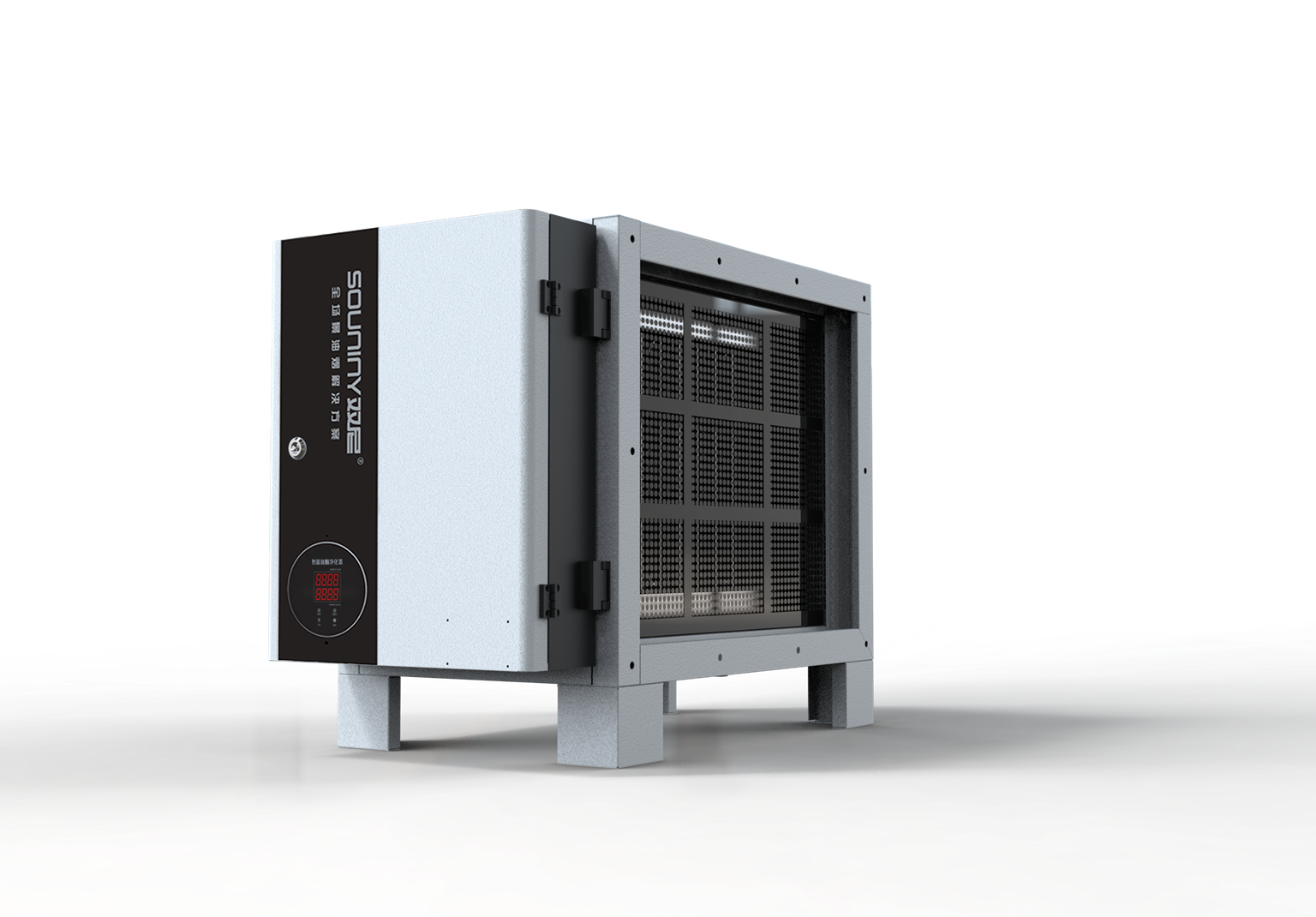
The high-voltage power supply is the most technologically sophisticated component in an ESP system — and the component that most distinguishes premium systems from budget alternatives. Souniny uses modern switched-mode power supply (SMPS) technology with intelligent control that significantly outperforms traditional 50/60Hz transformer-based supplies.
| Parameter | Specification |
|---|---|
| Technology | Switched-Mode Power Supply (SMPS), 20-50 kHz switching frequency |
| Voltage Range | 7-12 kV DC, continuously adjustable |
| Arc Detection | <1ms detection and suppression; automatic restart after arc clears |
| Efficiency | >92% (vs ~70% for traditional linear supplies) |
| Automatic Optimization | Continuous monitoring of cell current; voltage adjusted for optimal collection at minimum power |
| Protection | Over-voltage, over-current, over-temperature, short-circuit; all auto-resetting |
Application Scenarios
- Energy comparison field study: A 10-location restaurant chain compared Souniny SMPS-based ESP units against older linear-supply units at similar locations. Average energy consumption: SMPS units used 22% less electricity while maintaining equivalent or better collection efficiency. The SMPS units also showed 40% fewer power supply failures over 2 years — attributed to better thermal management and comprehensive protection circuits.
- High-humidity environment reliability (Singapore): In Singapore’s 80%+ humidity environment, traditional transformer-based supplies frequently experienced tracking and flashover on high-voltage terminals due to condensation. Souniny SMPS supplies with conformal-coated circuit boards and encapsulated high-voltage sections have demonstrated zero humidity-related failures across 50+ Singapore installations over 3 years.
- Arc detection and fire prevention: A cooking oil flare-up at a wok station caused a momentary flame to enter the ESP intake. The SMPS arc detection system detected the resulting electrical arc within 0.8ms, shut down high voltage, and auto-restarted after 5 seconds when the arc condition cleared. The system logged the event. A traditional supply without arc detection could have sustained the arc, potentially causing cell damage or, in worst case, ignition of accumulated grease.